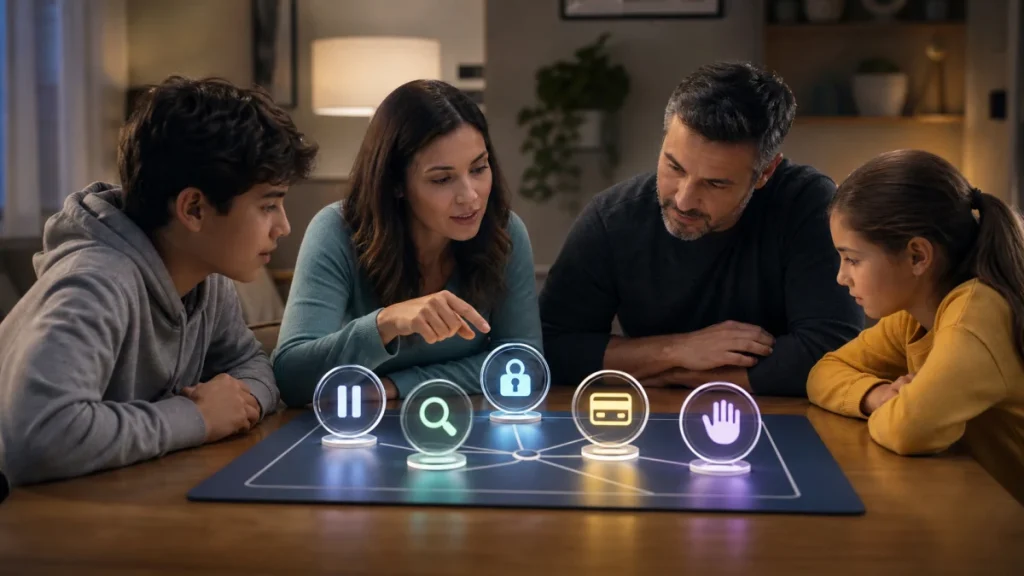
Every family should agree on a few durable rules: pause unexpected requests; never share passwords or one-time codes; verify money and emergency stories through another channel; ask before installing remote-access software; protect accounts with unique credentials and MFA; and tell someone quickly after a mistake.
The practical objective is to separate the claim from the channel that delivered it. Write the rules together, assign trusted contacts, configure recovery and spending controls, and rehearse what happens after a suspicious click or payment. That pause preserves your options and prevents the sender from defining both the problem and the supposed solution.
How the scammer tries to control the decision
Rules work when they cover behavior across changing apps. Children, adults, and older relatives encounter different lures, but each scam tries to convert trust or emotion into an action. A clear escalation path is more useful than expecting everyone to recognize every brand or technical trick. In this context, families are safer when verification is a shared routine rather than a test of technical skill. Scammers exploit emotion, authority, secrecy, embarrassment, and time pressure across phone calls, games, social media, jobs, relationships, donations, pets, and housing.
For a household online-safety agreement, focus on authorization and evidence rather than confidence. A sender can copy appearance, learn personal details, or automate a conversation; the sender cannot make an unrelated account, independently listed contact, or official record confirm an event that never happened.
Where the story stops adding up
When evaluating a household online-safety agreement, one clue may have an innocent explanation. Several clues surrounding a request for money, credentials, identity data, software, or secrecy create a much stronger reason to disengage.
- A rule is so technical or absolute that family members hide normal mistakes.
- Only children or older adults are trained while other members control recovery accounts.
- No one knows who to contact when the primary phone or email is unavailable.
- Money, gift cards, crypto, an advance fee, account credentials, or an identity document is requested before ordinary verification.
- A new online contact avoids an in-person meeting or independent identity check but quickly builds emotional or financial pressure.
- The offer is unusually cheap, lucrative, exclusive, or time-limited and discourages a second opinion.
Use a separate channel to establish the facts
Verification of a household online-safety agreement should create a new path that the original sender does not control. Work through the following sequence and stop as soon as the claim fails an independent check.
- Define the claim: Write the rules together, assign trusted contacts, configure recovery and spending controls, and rehearse what happens after a suspicious click or payment.
- Leave the supplied channel: Separate identity verification from emotion: a familiar voice, photo, profile, or convincing story is not enough by itself.
- Check the real record: Call the person, company, charity, school, landlord, or platform through contact information the family finds independently.
- Confirm with an authorized source: Use a family safe word or a question whose answer is not available on social media.
- Record the outcome: Invite a second trusted person into any urgent request involving money, credentials, intimate material, or a major commitment.
Do not let a verification call about a household online-safety agreement become a continuation of the suspicious conversation. Find contact details independently, explain only what is necessary, and never disclose a password or one-time code merely to ask whether a notice is real.
Build a broader safety plan
For a household online-safety agreement, a safer response also protects the accounts and channels surrounding this event. These related guides extend the same verification habit:
- For the next layer of verification, see the related teach teenagers social media scam awareness checklist before approving another request.
- If the event touches another account or payment, continue with a deeper explanation of gaming scams targeting children and parents.
- A related control is explained in Tech Support Scams Targeting Seniors: A Family Prevention Guide, which can help prevent a follow-on attempt.
- Use the practical guide to first 30 minutes after account hacked when the suspicious contact changes channel or asks for a different kind of proof.
Act on the access, data, or payment involved
Match the response to what actually happened during a household online-safety agreement. Opening a message, entering a password, installing software, sharing identity data, and sending money are different events and should not be treated as interchangeable.
- 1. Stop the current action and preserve evidence before deleting messages.
- 2. Tell the account owner, parent, caregiver, bank, or platform that can limit harm.
- 3. Review the event calmly and update one concrete control rather than assigning blame.
- 4. End contact without debating, save evidence, and tell a trusted person what happened.
- 5. Contact the payment provider, platform, school, charity, bank, or relevant organization through its official channel.
- 6. Secure any exposed account and warn family or friends if an impersonator may contact them next.
Move quickly after a household online-safety agreement, but avoid anyone who appears after the incident and guarantees recovery. Official providers may investigate or attempt a reversal; they cannot honestly promise that money, media, or account access will always be restored.
Reduce repeat and follow-on attempts
- Post a short pause-and-verify checklist near shared devices and revisit it after account or household changes.
- Agree on a household pause rule: no urgent payment, code, remote access, or sensitive document without an independent check.
- Practice the family safe word and callback plan before an emergency, including backup contacts.
- Use age-appropriate privacy controls, spending limits, alerts, unique passwords, and multi-factor authentication.
Prevention around a household online-safety agreement is strongest when it reduces the number of decisions made under pressure. Bookmarks, saved official contacts, unique credentials, account alerts, and a trusted second person turn an urgent story into a routine check.
What to do now
- ☐ Stop using the sender’s link, number, QR code, payment route, or download.
- ☐ Write the rules together, assign trusted contacts, configure recovery and spending controls, and rehearse what happens after a suspicious click or payment.
- ☐ Stop the current action and preserve evidence before deleting messages.
- ☐ Save the original message and a short timeline before blocking or deleting it.
- ☐ Post a short pause-and-verify checklist near shared devices and revisit it after account or household changes.
Frequently asked questions
Does a familiar name or logo prove the contact is real?
No. In the case of a household online-safety agreement, design, caller ID, fluent writing, profile badges, screenshots, and personal details can be copied, spoofed, stolen, or generated. Confirm the underlying event and authority through an independently reached source.
What should I verify first?
Write the rules together, assign trusted contacts, configure recovery and spending controls, and rehearse what happens after a suspicious click or payment. Do not use a destination supplied by the contact you are trying to authenticate.
What should I do after sharing information?
Stop the current action and preserve evidence before deleting messages. Tell the account owner, parent, caregiver, bank, or platform that can limit harm. The exact response depends on whether money, credentials, identity data, or device access was involved.
Can a security tool make this risk disappear?
No single clue about a household online-safety agreement is conclusive, and no response guarantees recovery. Evaluate the full request, preserve evidence, and use official providers and reporting channels rather than an unsolicited recovery agent.