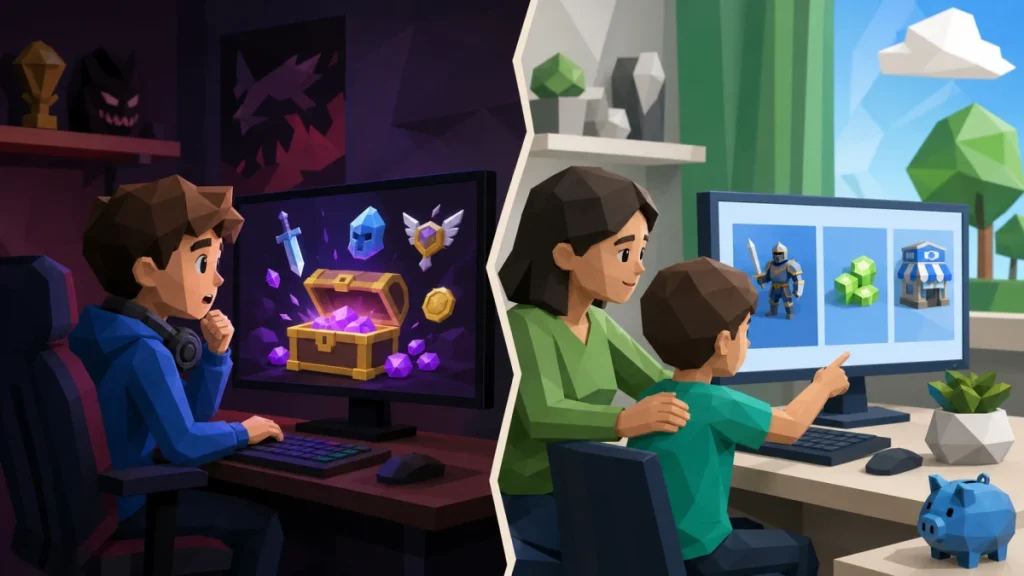
Keep game logins, trades, currency, and purchases inside the official game and platform. Do not share a password or code with a moderator or friend, scan a login QR code for a reward, or install an unofficial cheat or test build. Parents should use spending approvals and create an easy way to ask for help.
The practical objective is to separate the claim from the channel that delivered it. Check promotions in official game announcements, verify moderator roles, and review account and purchase history with the child before acting. That pause preserves your options and prevents the sender from defining both the problem and the supposed solution.
How the situation develops
Scams promise rare items, free currency, account upgrades, tournament access, or moderation help. A stolen player account can then target friends. Malicious downloads may steal both game sessions and other browser credentials, while off-platform trades remove support and transaction records. In this context, families are safer when verification is a shared routine rather than a test of technical skill. Scammers exploit emotion, authority, secrecy, embarrassment, and time pressure across phone calls, games, social media, jobs, relationships, donations, pets, and housing.
For a game trade, giveaway, moderator, or purchase, focus on authorization and evidence rather than confidence. A sender can copy appearance, learn personal details, or automate a conversation; the sender cannot make an unrelated account, independently listed contact, or official record confirm an event that never happened.
Warning signs worth investigating
When evaluating a game trade, giveaway, moderator, or purchase, one clue may have an innocent explanation. Several clues surrounding a request for money, credentials, identity data, software, or secrecy create a much stronger reason to disengage.
- A trade or reward requires leaving the game, sharing a code, or logging into another domain.
- A “developer” sends an executable or mobile profile for testing.
- The offer uses a friend’s compromised account and creates fear of losing a limited item.
- The offer is unusually cheap, lucrative, exclusive, or time-limited and discourages a second opinion.
- The contact reacts angrily or changes the story when asked to pause, call back, or involve another trusted person.
- A child, teenager, or older adult is told they will be punished, embarrassed, or lose an opportunity if they tell someone.
Verify the claim without following its instructions
Verification of a game trade, giveaway, moderator, or purchase should create a new path that the original sender does not control. Work through the following sequence and stop as soon as the claim fails an independent check.
- Define the claim: Check promotions in official game announcements, verify moderator roles, and review account and purchase history with the child before acting.
- Leave the supplied channel: Use a family safe word or a question whose answer is not available on social media.
- Check the real record: Invite a second trusted person into any urgent request involving money, credentials, intimate material, or a major commitment.
- Confirm with an authorized source: Verify the underlying opportunity through official records, a real-world visit, a company website, or a platform’s protected process.
- Record the outcome: Separate identity verification from emotion: a familiar voice, photo, profile, or convincing story is not enough by itself.
Do not let a verification call about a game trade, giveaway, moderator, or purchase become a continuation of the suspicious conversation. Find contact details independently, explain only what is necessary, and never disclose a password or one-time code merely to ask whether a notice is real.
Build a broader safety plan
For a game trade, giveaway, moderator, or purchase, the same evidence-based approach applies to nearby risks. Continue with the guides that match the next decision you face:
- A related control is explained in Tech Support Scams Targeting Seniors: A Family Prevention Guide, which can help prevent a follow-on attempt.
- Use the practical guide to romance scam warning signs for families when the suspicious contact changes channel or asks for a different kind of proof.
- For the next layer of verification, see these safety steps for verify a charity donation request before approving another request.
- If the event touches another account or payment, continue with the related first 30 minutes after account hacked checklist.
What to do if you already interacted
Match the response to what actually happened during a game trade, giveaway, moderator, or purchase. Opening a message, entering a password, installing software, sharing identity data, and sending money are different events and should not be treated as interchangeable.
- 1. Change credentials, end sessions, and contact official game support after account loss.
- 2. Remove suspicious software and review connected payment methods.
- 3. Report the account, server, trade, or item through platform controls.
- 4. Secure any exposed account and warn family or friends if an impersonator may contact them next.
- 5. Report threats, exploitation, or financial harm to the appropriate platform and official authority; call emergency services for immediate danger.
- 6. Respond without blame. Shame delays reporting and gives a scammer more time to cause harm.
Move quickly after a game trade, giveaway, moderator, or purchase, but avoid anyone who appears after the incident and guarantees recovery. Official providers may investigate or attempt a reversal; they cannot honestly promise that money, media, or account access will always be restored.
Make the next attempt less effective
- Use a unique game password, MFA, purchase PIN, and family agreement for virtual-item trades.
- Use age-appropriate privacy controls, spending limits, alerts, unique passwords, and multi-factor authentication.
- Keep conversations about online mistakes calm and routine so everyone can ask for help early.
- Agree on a household pause rule: no urgent payment, code, remote access, or sensitive document without an independent check.
Prevention around a game trade, giveaway, moderator, or purchase is strongest when it reduces the number of decisions made under pressure. Bookmarks, saved official contacts, unique credentials, account alerts, and a trusted second person turn an urgent story into a routine check.
What to do now
- ☐ Stop using the sender’s link, number, QR code, payment route, or download.
- ☐ Check promotions in official game announcements, verify moderator roles, and review account and purchase history with the child before acting.
- ☐ Change credentials, end sessions, and contact official game support after account loss.
- ☐ Save the original message and a short timeline before blocking or deleting it.
- ☐ Use a unique game password, MFA, purchase PIN, and family agreement for virtual-item trades.
Frequently asked questions
Is the contact safe if it uses HTTPS or a verified-looking profile?
No. In the case of a game trade, giveaway, moderator, or purchase, design, caller ID, fluent writing, profile badges, screenshots, and personal details can be copied, spoofed, stolen, or generated. Confirm the underlying event and authority through an independently reached source.
What is the safest first move?
Check promotions in official game announcements, verify moderator roles, and review account and purchase history with the child before acting. Do not use a destination supplied by the contact you are trying to authenticate.
Who should I contact after money or account access is involved?
Change credentials, end sessions, and contact official game support after account loss. Remove suspicious software and review connected payment methods. The exact response depends on whether money, credentials, identity data, or device access was involved.
Can I guarantee recovery by acting immediately?
No single clue about a game trade, giveaway, moderator, or purchase is conclusive, and no response guarantees recovery. Evaluate the full request, preserve evidence, and use official providers and reporting channels rather than an unsolicited recovery agent.