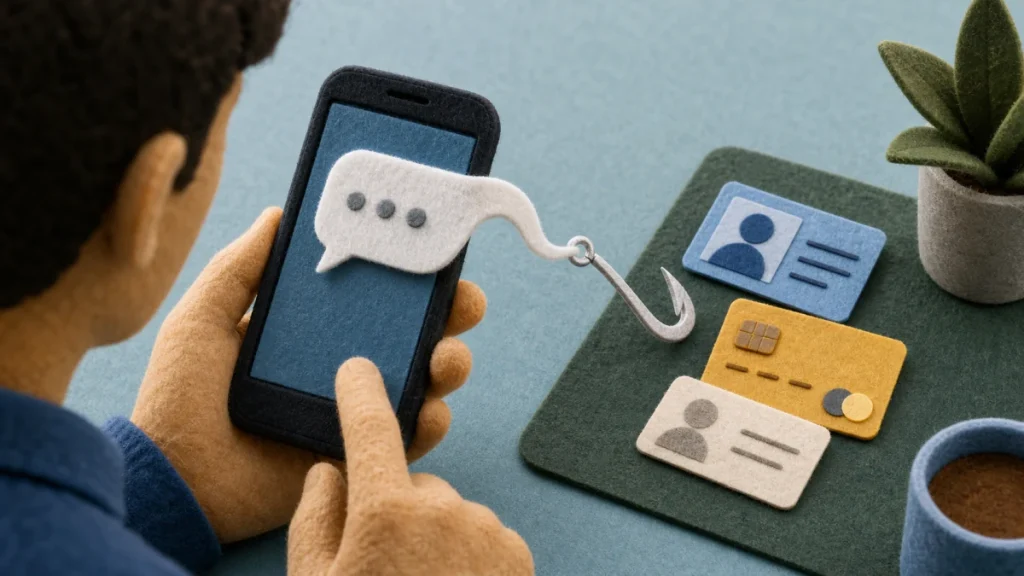
Smishing is phishing delivered by text or another mobile message. Do not tap its link, reply, or call its number. Check the claimed bank, carrier, delivery, toll, account, or prize through an independently opened app or known website, then report and delete the text after preserving anything needed as evidence.
The practical objective is to separate the claim from the channel that delivered it. Use the relevant official app or type the organization’s known address, then look for a matching transaction, shipment, balance, or alert. That pause preserves your options and prevents the sender from defining both the problem and the supposed solution.
What is happening behind the message
Email and text messages let an attacker imitate a trusted sender and place the victim one tap away from a credential form, malicious attachment, fake support number, or fraudulent payment request. A short message fits naturally on a phone and can exploit real-time concerns such as a card charge or package. The link often opens a mobile-friendly imitation designed to collect a password, card, address, or one-time code; a reply can also confirm that the number is active.
For an unexpected text message, focus on authorization and evidence rather than confidence. A sender can copy appearance, learn personal details, or automate a conversation; the sender cannot make an unrelated account, independently listed contact, or official record confirm an event that never happened.
Risk signals to evaluate together
When evaluating an unexpected text message, one clue may have an innocent explanation. Several clues surrounding a request for money, credentials, identity data, software, or secrecy create a much stronger reason to disengage.
- The sender is an unfamiliar number or email-to-text address and supplies a shortened or odd domain.
- A minor fee or quick confirmation requires complete card or identity details.
- The text claims urgency but omits a verifiable order, account, or transaction record.
- The message uses urgency, fear, a refund, a prize, or an account suspension to suppress careful checking.
- The sender asks for a one-time passcode, password, PIN, Social Security number, or complete card information.
- The visible sender name looks familiar, but the full address, reply-to address, or domain does not match the organization.
How to check the claim independently
Verification of an unexpected text message should create a new path that the original sender does not control. Work through the following sequence and stop as soon as the claim fails an independent check.
- Define the claim: Use the relevant official app or type the organization’s known address, then look for a matching transaction, shipment, balance, or alert.
- Leave the supplied channel: Contact the supposed sender through a separate known channel, especially when the message involves money, credentials, or changed instructions.
- Check the real record: Check whether you initiated the reset, code, shipment tracking, or support request. An unexpected workflow should remain unapproved.
- Confirm with an authorized source: Do not reply. Open the relevant app or type the known site address yourself and inspect alerts, orders, billing, and security activity there.
- Record the outcome: Expand the full sender and link destination without opening it. Identify the registered domain, not just words placed earlier in the address.
Do not let a verification call about an unexpected text message become a continuation of the suspicious conversation. Find contact details independently, explain only what is necessary, and never disclose a password or one-time code merely to ask whether a notice is real.
Build a broader safety plan
For an unexpected text message, once the immediate question is resolved, use these connected guides to reduce follow-on account, payment, or identity risk:
- If the event touches another account or payment, continue with these safety steps for verify a fake password reset email.
- A related control is explained in the related one-time password not requested checklist, which can help prevent a follow-on attempt.
- Use a deeper explanation of inspect a suspicious link safely when the suspicious contact changes channel or asks for a different kind of proof.
- For the next layer of verification, see Bank Fraud Alert Texts: How to Know Whether the Message Is Genuine before approving another request.
Response steps after possible exposure
Match the response to what actually happened during an unexpected text message. Opening a message, entering a password, installing software, sharing identity data, and sending money are different events and should not be treated as interchangeable.
- 1. Use the phone’s report-junk control and forward eligible carrier spam to 7726 where supported.
- 2. Contact the bank or card issuer if payment information was submitted.
- 3. Change affected credentials and review the device if an app or profile was installed.
- 4. Keep the original message and headers when reporting; screenshots alone can omit useful routing information.
- 5. Report the message with the mail or messaging provider’s phishing or spam control, then block the sender.
- 6. If you entered a password, change it from the real site, end other sessions, and change every account that reused it.
Move quickly after an unexpected text message, but avoid anyone who appears after the incident and guarantees recovery. Official providers may investigate or attempt a reversal; they cannot honestly promise that money, media, or account access will always be restored.
Strengthen the surrounding accounts and habits
- Enable spam filtering while keeping the independent-account check as the primary defense.
- Navigate to important accounts from bookmarks or official apps instead of links in unexpected messages.
- Teach household members that one-time codes approve access and should never be relayed to an unsolicited caller or texter.
- Maintain recovery email addresses and phone numbers so a real alert can be investigated without depending on the message.
Prevention around an unexpected text message is strongest when it reduces the number of decisions made under pressure. Bookmarks, saved official contacts, unique credentials, account alerts, and a trusted second person turn an urgent story into a routine check.
What to do now
- ☐ Stop using the sender’s link, number, QR code, payment route, or download.
- ☐ Use the relevant official app or type the organization’s known address, then look for a matching transaction, shipment, balance, or alert.
- ☐ Use the phone’s report-junk control and forward eligible carrier spam to 7726 where supported.
- ☐ Save the original message and a short timeline before blocking or deleting it.
- ☐ Enable spam filtering while keeping the independent-account check as the primary defense.
Frequently asked questions
Can accurate personal details authenticate the sender?
No. In the case of an unexpected text message, design, caller ID, fluent writing, profile badges, screenshots, and personal details can be copied, spoofed, stolen, or generated. Confirm the underlying event and authority through an independently reached source.
Why is a separate channel important?
Use the relevant official app or type the organization’s known address, then look for a matching transaction, shipment, balance, or alert. Do not use a destination supplied by the contact you are trying to authenticate.
How quickly should I act after exposure?
Use the phone’s report-junk control and forward eligible carrier spam to 7726 where supported. Contact the bank or card issuer if payment information was submitted. The exact response depends on whether money, credentials, identity data, or device access was involved.
Should I confront the suspected scammer?
No single clue about an unexpected text message is conclusive, and no response guarantees recovery. Evaluate the full request, preserve evidence, and use official providers and reporting channels rather than an unsolicited recovery agent.