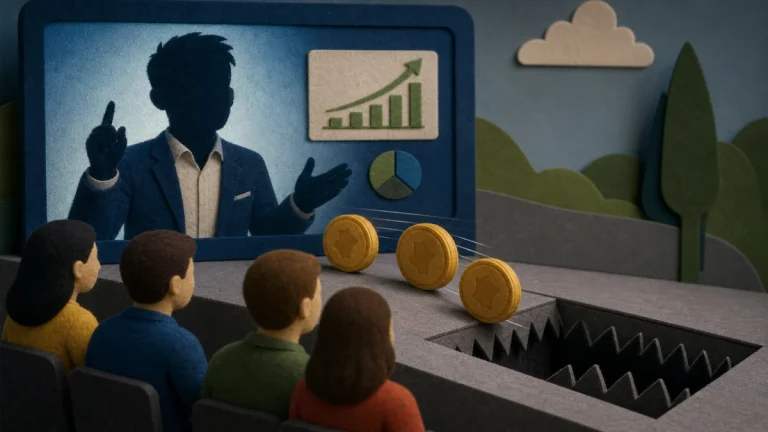
No set of visual glitches can reliably prove that a video is fake. Treat odd lip movement, lighting, edges, blinking, audio, and motion as prompts for investigation, then verify the original source, context, date, and underlying claim through independent primary evidence. Provenance is stronger than pixel guessing.
The practical objective is to separate the claim from the channel that delivered it. Find the earliest complete version, inspect the account that first published it, and look for confirmation from the depicted person or organization through an established channel. That pause preserves your options and prevents the sender from defining both the problem and the supposed solution.
What is happening behind the message
Generative tools can cheaply produce fluent messages, synthetic voices, altered video, and fabricated images. They improve an impersonation, but they do not change the safest defense: verify the person, account, and request through a separate trusted channel. Deepfake quality varies, and ordinary compression, editing, translation, and low bandwidth can create artifacts that resemble manipulation. Conversely, a well-made synthetic clip may look smooth. A scam succeeds when the viewer treats the clip as self-authenticating and acts before locating where it came from.
For a video whose authenticity matters, focus on authorization and evidence rather than confidence. A sender can copy appearance, learn personal details, or automate a conversation; the sender cannot make an unrelated account, independently listed contact, or official record confirm an event that never happened.
Risk signals to evaluate together
When evaluating a video whose authenticity matters, one clue may have an innocent explanation. Several clues surrounding a request for money, credentials, identity data, software, or secrecy create a much stronger reason to disengage.
- The clip begins mid-sentence, is heavily cropped, or omits the event and account that supposedly produced it.
- Audio, reflections, text, hands, mouth movement, or scene transitions are inconsistent—but only as clues.
- The post demands an investment, payment, credential, or rapid share before independent confirmation.
- The caller or message creates an emergency and resists any pause, callback, or second opinion.
- A familiar voice or face appears through a new number, new account, low-quality connection, or one-way recording.
- The story requires secrecy, an unusual payment method, a credential, or a move to a different messaging service.
How to check the claim independently
Verification of a video whose authenticity matters should create a new path that the original sender does not control. Work through the following sequence and stop as soon as the claim fails an independent check.
- Define the claim: Find the earliest complete version, inspect the account that first published it, and look for confirmation from the depicted person or organization through an established channel.
- Leave the supplied channel: Confirm the underlying event separately: check the real account, company directory, regulator database, family member, or official statement.
- Check the real record: Treat visual or audio artifacts only as clues. A convincing file can be fake, and an authentic compressed file can look odd.
- Confirm with an authorized source: End the incoming contact and call the person or organization through a number or account you previously verified.
- Record the outcome: Ask a question or use a family safe word that was never posted publicly and is unrelated to information available online.
Do not let a verification call about a video whose authenticity matters become a continuation of the suspicious conversation. Find contact details independently, explain only what is necessary, and never disclose a password or one-time code merely to ask whether a notice is real.
Build a broader safety plan
For a video whose authenticity matters, this incident rarely exists in isolation. The following related checks close common paths a scammer may try next:
- Use these safety steps for AI phishing email detection when the suspicious contact changes channel or asks for a different kind of proof.
- For the next layer of verification, see the related AI job interview scam warning signs checklist before approving another request.
- If the event touches another account or payment, continue with a deeper explanation of celebrity deepfake investment scam.
- A related control is explained in How to Tell Whether an Email Is Phishing, which can help prevent a follow-on attempt.
Response steps after possible exposure
Match the response to what actually happened during a video whose authenticity matters. Opening a message, entering a password, installing software, sharing identity data, and sending money are different events and should not be treated as interchangeable.
- 1. Save the URL and original file rather than repeatedly recompressing a screen recording.
- 2. Check whether credible primary records support the quoted statement or event.
- 3. Report impersonating or fraudulent media to the platform and the depicted party.
- 4. Report threats or fraud to the platform and the appropriate official channel; contact local emergency services for an immediate physical threat.
- 5. Do not pay, send intimate material, reveal a code, or continue negotiating while identity is unverified.
- 6. Preserve the original file, message headers, usernames, URLs, timestamps, and payment instructions.
Move quickly after a video whose authenticity matters, but avoid anyone who appears after the incident and guarantees recovery. Official providers may investigate or attempt a reversal; they cannot honestly promise that money, media, or account access will always be restored.
Strengthen the surrounding accounts and habits
- Build verification around source history and corroboration because visible artifacts will change as generation tools improve.
- Enable multi-factor authentication and login alerts so an impersonation does not easily become an account takeover.
- Create a family verification plan that includes callbacks, a safe word, and a second trusted contact.
- Limit public voice samples and personal details where practical, while recognizing that privacy settings cannot guarantee prevention.
Prevention around a video whose authenticity matters is strongest when it reduces the number of decisions made under pressure. Bookmarks, saved official contacts, unique credentials, account alerts, and a trusted second person turn an urgent story into a routine check.
What to do now
- ☐ Stop using the sender’s link, number, QR code, payment route, or download.
- ☐ Find the earliest complete version, inspect the account that first published it, and look for confirmation from the depicted person or organization through an established channel.
- ☐ Save the URL and original file rather than repeatedly recompressing a screen recording.
- ☐ Save the original message and a short timeline before blocking or deleting it.
- ☐ Build verification around source history and corroboration because visible artifacts will change as generation tools improve.
Frequently asked questions
Can a professional-looking message still be fraudulent?
No. In the case of a video whose authenticity matters, design, caller ID, fluent writing, profile badges, screenshots, and personal details can be copied, spoofed, stolen, or generated. Confirm the underlying event and authority through an independently reached source.
Should I reply before I verify it?
Find the earliest complete version, inspect the account that first published it, and look for confirmation from the depicted person or organization through an established channel. Do not use a destination supplied by the contact you are trying to authenticate.
What if I already followed part of the request?
Save the URL and original file rather than repeatedly recompressing a screen recording. Check whether credible primary records support the quoted statement or event. The exact response depends on whether money, credentials, identity data, or device access was involved.
Is one warning sign enough to prove a scam?
No single clue about a video whose authenticity matters is conclusive, and no response guarantees recovery. Evaluate the full request, preserve evidence, and use official providers and reporting channels rather than an unsolicited recovery agent.