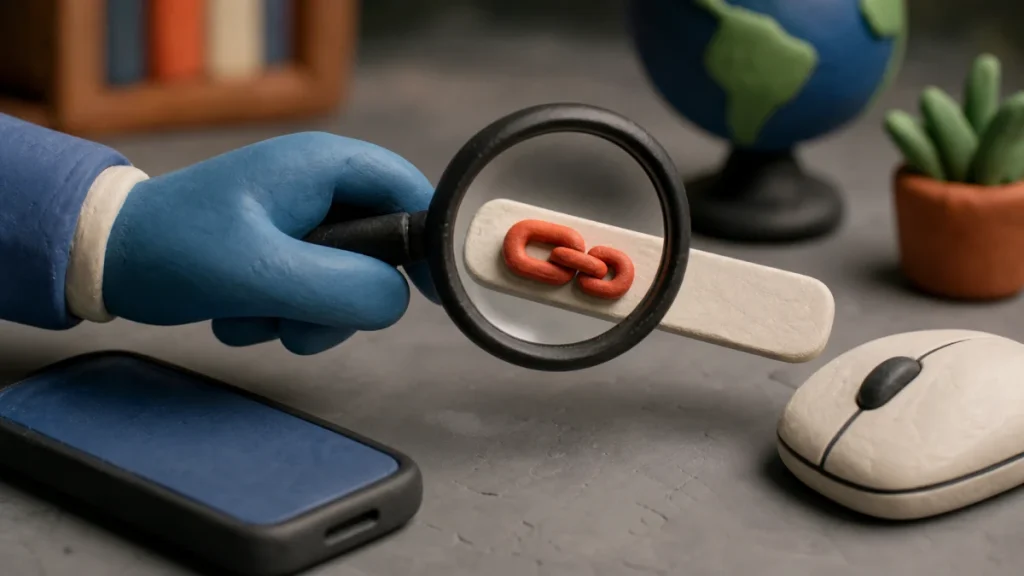
Inspect a suspicious link without navigating to it: reveal or copy its text into a plain-text note, identify the registered domain, and compare that domain with the organization’s official address. Do not paste it into a browser address bar, and do not upload a private reset or invitation link to a public scanner.
The practical objective is to separate the claim from the channel that delivered it. On desktop, hover to preview; on mobile, use the long-press preview without opening. When a legitimate task may exist, ignore the link and navigate to the service independently. That pause preserves your options and prevents the sender from defining both the problem and the supposed solution.
How the situation develops
Attackers hide destinations behind buttons, shortened URLs, QR codes, Unicode lookalikes, extra subdomains, and long paths. The meaningful ownership boundary is the registered domain immediately before the suffix, not a trusted brand word placed anywhere to its left or in the path. In this context, email and text messages let an attacker imitate a trusted sender and place the victim one tap away from a credential form, malicious attachment, fake support number, or fraudulent payment request.
For a link you do not want to open, focus on authorization and evidence rather than confidence. A sender can copy appearance, learn personal details, or automate a conversation; the sender cannot make an unrelated account, independently listed contact, or official record confirm an event that never happened.
Warning signs worth investigating
When evaluating a link you do not want to open, one clue may have an innocent explanation. Several clues surrounding a request for money, credentials, identity data, software, or secrecy create a much stronger reason to disengage.
- The address uses a misspelling, unexpected country suffix, raw IP address, or brand name only in a subdomain.
- A shortener or redirect hides the final destination for a sensitive login or payment.
- The URL contains a personal token, so sharing it with a scanner could expose access.
- A link label looks normal while its actual destination uses a misspelling, unrelated host, or misleading subdomain.
- The message asks you to sign in, reset a password, update billing, or confirm delivery through an embedded link.
- An attachment or QR code arrives without context, including from a contact whose account may have been compromised.
Verify the claim without following its instructions
Verification of a link you do not want to open should create a new path that the original sender does not control. Work through the following sequence and stop as soon as the claim fails an independent check.
- Define the claim: On desktop, hover to preview; on mobile, use the long-press preview without opening. When a legitimate task may exist, ignore the link and navigate to the service independently.
- Leave the supplied channel: Expand the full sender and link destination without opening it. Identify the registered domain, not just words placed earlier in the address.
- Check the real record: Compare the request with the provider’s official help guidance, reached independently from its website or app.
- Confirm with an authorized source: Contact the supposed sender through a separate known channel, especially when the message involves money, credentials, or changed instructions.
- Record the outcome: Check whether you initiated the reset, code, shipment tracking, or support request. An unexpected workflow should remain unapproved.
Do not let a verification call about a link you do not want to open become a continuation of the suspicious conversation. Find contact details independently, explain only what is necessary, and never disclose a password or one-time code merely to ask whether a notice is real.
Build a broader safety plan
For a link you do not want to open, a safer response also protects the accounts and channels surrounding this event. These related guides extend the same verification habit:
- For the next layer of verification, see Email Spoofing Explained in Simple Terms before approving another request.
- If the event touches another account or payment, continue with the practical guide to fake Microsoft security email.
- A related control is explained in these safety steps for verify a fake Apple ID alert, which can help prevent a follow-on attempt.
- Use the related verify a bank fraud alert text checklist when the suspicious contact changes channel or asks for a different kind of proof.
What to do if you already interacted
Match the response to what actually happened during a link you do not want to open. Opening a message, entering a password, installing software, sharing identity data, and sending money are different events and should not be treated as interchangeable.
- 1. Cancel any accidental navigation before entering data or approving a download.
- 2. Report the source message and preserve the displayed and actual URL.
- 3. If credentials were entered, secure the real account and every account that reused them.
- 4. If you opened a file or installed an app, update the device and run a trusted security scan before using it for sensitive recovery.
- 5. If financial data was submitted, contact the issuer or bank immediately and monitor for unauthorized activity.
- 6. Keep the original message and headers when reporting; screenshots alone can omit useful routing information.
Move quickly after a link you do not want to open, but avoid anyone who appears after the incident and guarantees recovery. Official providers may investigate or attempt a reversal; they cannot honestly promise that money, media, or account access will always be restored.
Make the next attempt less effective
- Learn to locate the registered domain and still prefer independent navigation for any consequential action.
- Use unique passwords, multi-factor authentication, automatic updates, and provider phishing protections.
- Navigate to important accounts from bookmarks or official apps instead of links in unexpected messages.
- Teach household members that one-time codes approve access and should never be relayed to an unsolicited caller or texter.
Prevention around a link you do not want to open is strongest when it reduces the number of decisions made under pressure. Bookmarks, saved official contacts, unique credentials, account alerts, and a trusted second person turn an urgent story into a routine check.
What to do now
- ☐ Stop using the sender’s link, number, QR code, payment route, or download.
- ☐ On desktop, hover to preview; on mobile, use the long-press preview without opening. When a legitimate task may exist, ignore the link and navigate to the service independently.
- ☐ Cancel any accidental navigation before entering data or approving a download.
- ☐ Save the original message and a short timeline before blocking or deleting it.
- ☐ Learn to locate the registered domain and still prefer independent navigation for any consequential action.
Frequently asked questions
Does a familiar name or logo prove the contact is real?
No. In the case of a link you do not want to open, design, caller ID, fluent writing, profile badges, screenshots, and personal details can be copied, spoofed, stolen, or generated. Confirm the underlying event and authority through an independently reached source.
What should I verify first?
On desktop, hover to preview; on mobile, use the long-press preview without opening. When a legitimate task may exist, ignore the link and navigate to the service independently. Do not use a destination supplied by the contact you are trying to authenticate.
What should I do after sharing information?
Cancel any accidental navigation before entering data or approving a download. Report the source message and preserve the displayed and actual URL. The exact response depends on whether money, credentials, identity data, or device access was involved.
Can a security tool make this risk disappear?
No single clue about a link you do not want to open is conclusive, and no response guarantees recovery. Evaluate the full request, preserve evidence, and use official providers and reporting channels rather than an unsolicited recovery agent.